Commercial Waste Canary Wharf: Recycling and Sustainability for an Eco-Friendly Waste Disposal Area
Canary Wharf is one of London's busiest business districts, and Commercial Waste Canary Wharf services must balance high-volume collections with responsible, long-term environmental thinking. Our overview of the eco-friendly waste disposal area approach explains how offices, retail outlets and building managers can reduce landfill through targeted recycling, reuse and diversion schemes. This page describes how a sustainable rubbish area at the estate level can support borough policies while delivering practical benefits for occupiers.
Why a sustainable rubbish area matters for commercial waste in Canary Wharf
Waste in Canary Wharf is not just refuse; it is a resource stream. By positioning Canary Wharf commercial waste as part of an integrated circular economy, businesses can cut costs, lower carbon, and support local regeneration. The focus is on increasing the recycling rate across mixed office waste, construction spoil, food waste and e-waste collection while maintaining a tidy, secure, and compliant waste footprint.
Local infrastructure: transfer stations and borough approaches
To create a true eco-friendly waste disposal area in the Docklands, reliable transfer stations and processing hubs are key. Local transfer stations in and around East London, including facilities in Poplar and Beckton, accept segregated streams from Canary Wharf and nearby boroughs. Tower Hamlets' approach to waste separation—encouraging dry mixed recycling, glass, and separate food waste streams—aligns with the estate's strategy for commercial rubbish Canary Wharf management.
 The network of transfer stations shortens haul distances, allowing dependable consolidation of materials before onward transfer to recycling facilities, anaerobic digestion plants or specialist e-waste processors. This reduces vehicle mileage and emissions and enables higher capture rates for paper, cardboard, plastics, glass and organic waste.
Key recycling activities in the area reflect the mix of uses: high-volume office paper recycling, segregated coffee cup and can collection at foodcourt hubs, dedicated electronics recycling for tenant upgrades, and careful management of construction and fit-out waste. These streams mirror borough-level initiatives that encourage source separation and material recovery.
Practical measures for achieving a sustainable rubbish area include on-site segregation bays, programmable compactors, and clear signage for tenants. A managed approach to commercial waste in Canary Wharf involves scheduled collections that match peak office hours, containing contamination and maximising recyclable capture. Building managers can deploy colour-coded bins and conduct periodic audits to track progress.
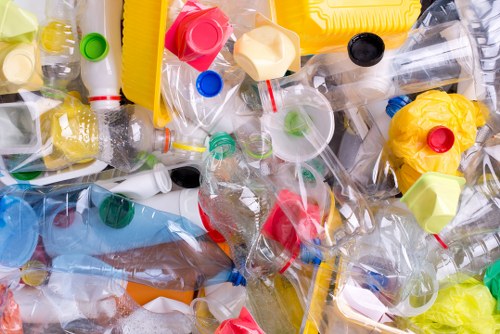 Partnerships are central to success: many organisations collaborate with local charities to divert reusable items like office furniture, phones and laptops to community projects. These partnerships provide social value while extending product lifecycles and reducing the volume of waste sent to treatment. Charitable reuse channels complement commercial recycling and support a circular model that benefits both the environment and local residents.
 Fleet and low-carbon logistics play a decisive role. Transitioning to low-carbon vans—electric and hybrid models used for last-mile collections—cuts emissions in the estate and nearby streets. Consolidated pick-ups scheduled to avoid congestion, combined with low-emission vehicles and route optimisation, make the eco-friendly waste disposal area a practical reality for Canary Wharf businesses.
To measure success we set an ambitious recycling percentage target: 70% divert-to-recycling for non-hazardous commercial streams within three years, rising to 80% by year five for estate-wide operations. This target includes paper, cardboard, glass, metals, plastics and organic material, and excludes regulated hazardous wastes which follow separate compliance routes. Monitoring includes weight-based reporting, contamination checks, and transparent KPI dashboards shared with occupiers.
Actions to reach these targets include:
- Source segregation at tenant and building levels to reduce contamination.
- Contracted reuse partnerships with charities to divert furniture and IT.
- Use of local transfer stations to shorten haulage and enable specialist processing.
- Deployment of low-carbon vans and consolidation services for last-mile collection.
The boroughs surrounding Canary Wharf each contribute to a coherent regional policy: Tower Hamlets encourages food waste capture and communal recycling hubs, while neighbouring Greenwich and the City of London coordinate on construction waste and hazardous material handling. Aligning estate practices with these borough approaches ensures compliance and better recovery rates for mixed streams.
Implementation takes collaboration: landlords, occupiers, cleaning contractors, and waste operators must agree common standards for labelling, frequency of collections and permissible materials. Regular training for concierge and cleaning teams reduces contamination and raises capture rates for key materials like confidential paper, aluminium cans and disposable coffee cups. Clear roles and shared targets create momentum toward a resilient sustainable rubbish area.
Beyond operational change, incentives such as reduced service charges for high-performing tenants, recognition schemes for sustainable fit-outs, and charity-driven reuse days reinforce positive behaviour. Working with local charities amplifies social impact by redistributing reusable goods while diverting significant tonnage from the waste stream.
Commercial Waste Canary Wharf strategies make the difference between waste management and resource management. By combining targeted recycling targets, strong partnerships with charities, the use of local transfer stations and low-carbon vans, Canary Wharf can become a model for an eco-friendly waste disposal area and a truly sustainable rubbish area in London's business district.
